|
|
|
||||
|
Buying New Cars How To Buy New Cars Buy Cars Online First Time Car Buying Tips Hybrid Car Buying Tips Extended Auto Warranty Tips Canadian Car Buying Tips Top 10 Car Dealer Scams Military Personel Car Buying Our Reader's New Car Deals Auto Finance Auto Loans, Tips & Scams Auto Refinance Tips & Scams Bad Credit Auto Loan Tips Used Car Loan Tips Get Your Credit Report Online Used Cars Used Car History Reports How To Buy Used Cars Selling Your Used Car Used Car Classifieds Auto Auction Buying Tips Car Insurance Car Insurance Buying Tips Auto Leasing New Car Leasing Tips ALG Residual Values Car Leasing Software Reviews Government Sites Attorney General Sites DMV Sites - All 50 States Drivers License Sites Take A Break New Car Dealers - Ratings Rate Your Dealer Experience Free Spreadsheet Downloads Humor: Alternate Car Names RV Buying Tips & Scams How To Jump Start A Car LoserCars.com Crash Of The Month Gallery Furniture Buying Tips |
Chapter 3: Dos & Don'ts at the car Dealer, Glossary of Fees
For car loans try sites such as Up2Drive, with lower APR than banks and approval online in minutes. You can get new car loans, or used car loans. They FedEx your check the same day, so you could apply today, and pay for your car tomorrow, it's that quick. Finance your car in advance and avoid all the loan scams at the dealer. See if the dealer can match your online car loan approval. Entering The Automobile Dealership, what to bring in "The Folder"
NEVER BUY THE FIRST TIME YOU GO IN. Car dealers tell you your internet car pricing is "way off", so remind them most cars don't increase more than $200 between model years, so your price isn't "too far off". My cars were 100% correct when I went shopping. Manufacturers give you less for your money by skimping on options and forcing overpriced options on you. Lexus charged $1050 for a Mitsubishi CD changer. I could have bought a nicer Denon changer in the stores for $450. It left a bad taste in my mouth that Lexus forced us to buy their garbage Mitsubishi CD changer, which has been nothing but problems since, and they've had to replace it twice already. Mercedes may charge $1300 for "full leather" in the E-class as opposed to "seating surface only". In the C-Class, they charged $1300 for only "partial leather". Your $45,000 car is really $46,300 if you want real leather. Most manufacturer's offer "partial leather" or some BS called "Leatherette", and salesman don't tell you that you just paid $1300 for a few strips of it. You could buy a Natuzzi leather couch for the same price. TV ads can list a lower "base" price. But go to the dealer, you'll find $3000-$5000 worth of "forced options". "Power Seats" does not mean both seats, the passenger seat is manual. You pay $700 for "power seats", but only on the driver's side. By skimping on the 2nd motor, car makers keep the price stable, but improve their profit margins by giving you less. Would you buy a car from me if I my TV ad said "Come on down to Crazy Jeff's and get your Supermobile with a power driver's seat while the loser passenger suffers with an old style manual seat." Another disturbing trend is they charge you A LOT EXTRA for the paint colors you and I actually want. Black or white paint is free, but if you go metallic, better reopen your wallet. Mazda charges $380 for their Pearl White, which is the worst Pearl White I've seen on any car in its class. It's no Lexus. Mercedes charged $600 extra for metallic paint. I'm no arbitrageur of fine paint, but I'd like to know what makes 2 gallons of paint with some metallic glitter in it worth $600? Isn't price gouging supposed to be illegal? |
||||
|
Whenever you see the advertised words "as low as", it really means "as much as...".TM |
|
|
Shopping Around For Cars and Test Driving:
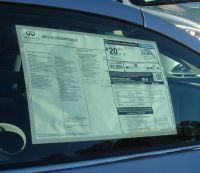
As you enter the dealership, remember your goal. Get pricing and option info from the MSRP sticker, find out what options your car is supplied with.
Their goal is to keep you from leaving without buying. They don't want you to go elsewhere to comparison shop. While shopping around, inform the
salesperson you are definitely not buying today, no matter what. The better salesman know not to pressure you, if you want the car, you'll be back. Just say No,
unless you are ready. "What if I told you can drive off today with no money down? Let me get this straight, you don't want to save over $1500? What will it
take to put you in this car today?" Tell Them "Even if it was free, I would not buy today, I'm weighing all my options."
Write down all the option packages, you'll need this info later to form your offer.
If your salesman turns out to be a woman, a big red flag should go up. People let down their guard with women. Some men think they can outsmart any woman. As they bask in their ego, she's out maneuvering them. The women are just as clever as men. As one internet sales manager emailed me to say, "A red flag should go up if your salesperson is not willing to work with you in a comfortable friendly atmosphere". Once salespeople get you in their den, they work on you, passing you between 2 or 3 salespeople, each one better than the next.
|
|
Salespeople need your Euphoria!
During the test drive don't act excited, they need your euphoria. They'll say "Isn't this great"? feeding the euphoria, and they have you hooked. All you want to do
is get the pricing info. If they turn on the radio, turn it back off. You want no distractions, while listening for strange vibrations or rattles. Music from the
radio may get you in a partying mood, which you don't want. Act flighty and indecisive, unimpressed, go back and forth between liking sport and sedan. They can't
figure you out, and they don't have you in a spell. Whoever is asking the questions controls the conversation, so you ask all the questions. Everything
they say is false until you see it in writing. They promised us free rear floor mats when we bought our Ford Probe in 1992:
Sure, Jeff, I'll give you floor mats. The parts department is closed,
so stop by Monday and I'll have them."
We showed up on Monday, and guess what? Mr. Liar doesn't work Mondays! They refused to give us the mats, and Mr. Liar dodged our subsequent calls. If they promise you anything, no matter how sincerely, make them put it in writing. "We'll be back to buy the car when you have the floor mats."
|
Car Buyer Emptor: If they don't put it in writing, it means they won't do it.TM |
Take the test drive, remain silent
During the test drive they want as much info out of you as possible. Anything you say will be used against you. They want to know what monthly payment can you afford,
and they want your trade-in. Tell them nothing. They are conditioning you as a payment buyer. They determine what payment you are happy with, shielding you from the
selling price. Tell them you don't deal that way, you negotiate based on its price, not monthly payments. Test the AC. Is it cold? Does cool air reach back seat? Test
drive on a hot sunny day to test the AC. Always inspect the car in daylight, not in the dark, for any nicks, or dents. Inspect the paint and make sure it's in good
condition. Don't let them deny rebates that you know are valid. Print the pricing and package/option info from the manufacturer's sticker so you can look up dealer
cost. The internet pricing sites also list the invoice price of options. Ignore the dealer's sticker. Get the sales person's card, thank them, and tell them you'll be
back. This is only a fact finding mission. Don't let them try to sell you at this time, as you are unprepared, and they know it. If they try to create a sense of
urgency for you to buy today, ignore it. The "urgency" is for them to sell and not let you walk out of there. Some no haggle places may sit down with you to give you
some numbers and not pressure you to buy today. That's OK too.
Here A Fee, There A Fee, Everywhere A Fee Fee
Ask if the dealer charges advertising fees, dealer prep, or other fees, and find out what the destination charge is. Make sure it agrees with what you found on the car
pricing sites. Knowing the fees is important when you end up comparing similar deals. Fees can add up to over $1000, throwing off all your budget calculations. You
must know all the fees your dealer plans to charge so you can factor them into your budget and formulate your offer accurately.
|
|
Glossary Of Fees you may see at a new car dealership:
"ADM" or "ADP" Charges (Additional Dealer Markup)
Bogus charges added by greedy dealers. It means "Additional Dealer Markup" or "Additional Dealer Profit", and appears on a sticker next to manufacturer's MSRP sticker.
I call it Arrogant Dealer Markup. ADM is an artificial buffer to bargain down the price. If ADM is $1000 and you talk them down $800, you still paid MSRP plus $200 for
the car! If you see this toxic waste, have them nix it. One buyer of a Honda Civic got the dealer to drop a $1995 ADM! But what if she had no idea what was going on?
Advertising Fees
Usually when you buy through discount sites like InvoiceDealers,
Cars.com,
Yahoo!Autos,
Edmunds.com,
MyRide.com and
CarsDirect you avoid ad fees. Car makers charge dealers for regional and national
advertising campaigns. These charges are reflected on the invoice and are a legitimate cost of doing business. This is where opinions differ, as I feel it's
their cost of doing business, not ours. Tell them to pay your fees like gas, wear and tear, and your time for driving all over town to shop for
the car. Many dealers are sticklers about this fee, and it's difficult to get them to drop it, but some do waive the fee. If a dealer adds on their own advertising
fee above and beyond this, they are out of bounds. Dealers try to charge $250-$1000, but it should not be more than $250. You're not paying for their inability to find
cost effective ads. $1000 ad fees allow the dealer to charge you a lower price on the car. You think you're saving money, but ad fees take it right back. This fee may
also show up as "Sales Promotion Fund", or DAA, or ADA, or anything referring to ads.
Edmund's says it's non-negotiable, but they are wrong. Anything in life is
negotiable, and I don't give up that easily. What angers me the most is the cryptic way that dealers hide this fee from you by using huge acronyms, then playing stupid
when you question it. "Duh, I don't know, we always charge this fee". A Nissan Dealer in Chicago told one of our visitors that they have to charge the
Nissan advertisement fee and can't drop it or they can face a class action law suit. Nice scam. Where's my bull icon?
Ford dealers use the cryptic term "FDAF/LMDA" on their invoice. "FDAF" stands for "Ford Dealer Advertising Fund", and the "LMDA" stands for Lincoln Mercury Dealer Advertising. Why can't they just disclose it as "ad fee"? I didn't pay an ad fee for my Lexus in 1998 or the Mazda Millenia in 1999. Honda add fees are built into the invoice price, don't let them charge you extra. Other companies choose their own cryptic acronym, like DAA (Dealer Area Advertising), TDA (Toyota Dealer Advertising Fee), HDA, you get the picture. If it ends with an "A", it's most likely an advertising fee. Speaking of advertising, dealers are neither grateful nor shy about plastering their name on the trunk of your shiny new car at a cost of $0 to them. You then spend the next several years advertising their dealership free of charge with your moving billboard. You should charge them a $600 advertising fee for that.
"Dealer Floorplan Assistance" Fees/Wholesale Financial Reserves/Dealer Interest Fee
Some dealers charge this fee, which is icing on the cake. Have them remove this insult. Dealer Floorplan Interest is the interest that dealers pay for loans to buy the
cars on their lot. Usually the factory pays this as part of the holdback, itemized as a separate invoice item. Floorplan interest can cost $150 per month for each car.
On an Eclipse invoice I have, the factory gave the dealer $185 in floor plan assistance, and the dealer itemized it to the buyer as a fee, double collecting for $370!
The factory gives the dealer 1-2 months of interest. The longer the car sits unsold on the lot, the more $150 interest checks the dealer pays. They want you to
"assist" them in "paying it", which is the factory's expense, not yours. Dealers know we are on to them, so some have changed the name to a confusing term called
"Wholesale Financial Reserves." or "Dealer Interest Fee".
"Dealer Markup Value" Fees in Hawaii
Dealers in Hawaii charge a "DEALER MARKUP VALUE," fee of $1000-$5000 over the selling price. They claim it offsets "high" transporting costs from the US mainland to
Hawaii. Our visitors have bought cars in Los Angeles and shipped to Hawaii for $895. If my geography serves me correctly, Japan is closer to Hawaii than the US, so it
should be cheaper to send Japanese imports from Japan to Hawaii. I suggest you let them charge no more than $600.
Dealer Prep
The most common scam, because it's so believable. They act like a team of NASA experts performed a 3 day 15,000 point check of your car. Dealer prep "covers their
cost" of removing plastic films on the seats, vacuuming the car, and preparing it for sale, done by their lowest paid employee. But most MSRP stickers show these
costs are covered by the car maker. Here's the MSRP sticker from my Lexus SC300:

See What I mean?
The factory pays the dealer for this pre-delivery service. When my Lexus SC300 arrived, it took the dealer 2 hours to peel the film, remove cardboard, install fuses, check the liquids, perform a 10 mile test drive, and hand me the keys. If a dealer charges a $500 dealer prep, you're paying them $250 per hour! Are you boiling mad yet? Often it's permanently printed on the buyer's form to make you think it's mandatory, but nearly everyone I know is able to make the dealer drop it by adding a credit to the next line. If they refuse to remove it, just walk. Tell them you want to see if the other local dealers will drop the fee.
Destination Charge
Dealers pay a destination charges to have cars delivered on auto transport trucks. For my 1998 Lexus SC300, it's $495, passed on to us. This is
one of the few legitimate fees. Verify the amount with online pricing sites before you go in to buy.
Documentation Fees
Expenses like registration, tags, title, and other state fees. Determine the fees your state charges before you go shopping. Call the Department of Motor Vehicles to
determine the cost of registering a new car, and getting the tags if necessary. It may be cheaper to transfer the tag from your old car to the new one. Once you know
all documentation fees, determine if the dealer is padding the charge. Have the salesman give a breakdown of every fee in writing.
Drive off Deposit
A bogus fee that greediest of dealerships pile on those with bad credit. The purpose of this fee is to steal your rebate from you. One reader had a $900 rebate on his
car, but the dealer stole it right back with a $900 drive off deposit. What does "Drive Off Deposit" mean? Nothing, it's a meaningless term. If you see a drive off
deposit on your worksheet, just drive off, no deposit.
Window VIN# Etching Fee
A stupid fee for etching the VIN# or other anti theft information into your side windows. It costs next to nothing for the dealer to do it, and the average fee is
about $300. You can buy same kit in auto parts stores for $20, and do it yourself.
Factory Holdback
US auto makers pay dealers a "factory holdback" of 3% MSRP on every car sold. Mercedes pays 3%, Lexus is 2%, but
Edmunds claims Lexus has no holdback. BMW, Japanese
imports, etc., pay 2% quarterly to the dealership. It's called holdback, because the factory holds back money from the dealer until they sell the car. This is
accounted for by charging the dealer for holdback on the invoice, paying them back when the car is sold. On a $30,000 car, the holdback is $900. This appears to you
and me as though the dealer paid $900 more for the car than he did. This is done by the factory as a means to compensate dealers for interest on loans that they take
out to buy the cars from the factory, and also to provide a little bit of profit to the dealer. The holdback is included in every invoice price. This is how dealers
can sell you a car at invoice, because the factory refunds them the holdback once the car is sold. They can sell you a $30,000 car at invoice and have a $900 positive
cash flow. Many people don't know holdback exists, including many car salesman, as this goes directly to the dealer, and it effectively reduces the dealer's cost of
the car. Many dealers deny it exists, or tell the customer it's a dealer expense, and try to add it on to the contract make the customer "pay" for it. It's the
factory's expense once the car is sold. Now the dealer is double collecting. If any dealer tries to itemize you separately for holdback, leave
immediately, you'll surely be subject to many more unscrupulous tricks. Don't let a dealer tell you there's no holdback, it's the business plan that the whole
industry is structured to. Denial is a popular trick used by dealers in Hawaii. But many good car dealers list holdback on their web sites.
LieNance Managers
That's my funny name for some Finance Managers who lie and cheat, for example, telling you that your credit score is too low to get a good APR, or
telling you that the bank requires you to buy a warranty, gap insurance, VIN etch, or credit life in order for you to get the loan.
Port Prep Fee or Port Installed Options (PIO)
These are fees for prep or options installed at the port of entry by the manufacturer. For example, Toyota has a Port Installed Option added to the cars once they
land in Florida called ToyoGuard, an extremely overpriced rubberized coating sprayed inside your wheel wells to prevent rust. Sometimes this adds up to $600 your
Toyota. Some port prep fees might only be $25. VW in Washington D.C. seems to have some PIOs that are unavoidable too..
Registration Fees
That's a tough one to determine, each state is different. There may also be small tire and battery fees around $10 levied by the state. In Florida, it's cheaper
to transfer your plates from the trade-in to the new car, about $50 instead of $180 for new plates. Some states charge hundreds, so check with your DMV before going
shopping. Print out the DMV fees online and bring them to the dealer. Quite often dealer charge up to $400 "document fees" supposedly to handle paperwork
transfer of the plate, done by their lowest paid secretary. Give me a break.
Washington Association Fee
Buyers in Washington D.C. buying a Volkswagen said the dealer tried to charge a $175 Washington Association Fee claiming it was "the cost that the manufacturer
charged them for doing business in this area". We don't know if this is a valid fee or not. It sure sounds like a bogus charge to me.
Factory To Dealer Incentives
You and I don't know about these. Sometimes
Edmunds lists them, but they don't always show all the ones available. Incentives can be huge, and reduce the
dealer's effective cost to buy the car. If there is one available on your car, many dealers are willing to give up some of it.
Factory To Consumer Incentives (Rebates)
Rebates are paid by the factory to you, or the dealer subtracts it from the price. Some states charge sales tax on it. A common scam at "No Haggle" dealers is to
charge lower than MSRP, (MSRP - Rebate), so you really aren't getting a deal, so ask if the price includes a rebate. Rebates can be $500-$2000 or more, and put you
ahead when you resell it years later. The rebate is from the factory, NOT the dealer. Don't let them jack up the price "because we are giving you a rebate", the
dealer has nothing to do with the rebate. The factory subsidizes lower APR leases and 2% loans in lieu of rebates, but you need stellar credit.
CarMax Used car Dealers
CarMax prices are high according to critics, and they don't deny it. When dealing with any used car dealer,
be sure you know the market
value of the car, get all claims in writing, don't buy any car without a 30 day guarantee, and never sign an "As Is" paper! For more complete details on buying used
cars read How To Buy A Used Car & Avoid Scams.
Conversion Vans, Custom Vehicles
These are difficult find pricing. Conversion vans are sent by the manufacturer to a company who installs fancy molding, doors, windows, wheels, etc. They look better,
and you pay more. But pricing sites have no info on custom vehicles. No one knows the pricing, so don't ask me. You can be taken for a ride because you are flying
blind, with no reference pricing, but if you don't mind paying up to $9000 extra it's OK. Don't expect good resale value, they aren't popular or easy to resell. The
"extras" packages that you will be given the hard sell on, including paint sealant and fabric treatment, will VOID your conversion package warranty. Have the dealer
put it in writing it will not void the warranty. Ask to see the conversion warranty. If they don't have it, tell them to call the conversion company, you want to
speak to them. If you get a song and dance, it's time to leave. Anytime they try to get out of giving you the information you ask for, it's time to leave. Call the
conversion company ahead about the warranty.
|
How To Price Honda Options If you plan to buy a new Honda Accord, Civic, CRX, S2000 or Odyssey, here are some pricing tips. Honda options are installed by the dealer so it's impossible to lookup dealer cost, and dealers can charge what they want. You should negotiate the cost of all options. Buyers have talked dealers down on the A/C from $1295 to $900. Use Toyota's option pricing as a "competitive guide". Honda and Toyota are rivals, so tell them Honda options should cost less than Toyota. Honda ad fees are built into the invoice price. If they separately charge you for it they are ripping you off. Look at my $avOmeter car deals database of other visitors to our site, where they report how much they paid for their new car. Use these sites to get quotes before going to a dealer: InvoiceDealers, Cars.com, Yahoo!Autos, Edmunds.com, MyRide.com and CarsDirect. Our visitors have reported great savings from these sites, and you'll negotiate to win. |
|
It's really a dumb lease! I don't recommend balloon payments! Just like interest only mortgages when the payment jumps up to include principal, no one is ready for them when they come due. |
Toyota's Scion Division usually Sells At Full Sticker Price
Toyota's Scion Division normally does not haggle the selling price, they sell you Scion's
at full sticker price. But one Scion dealer did email me to say they did
haggle a little, so try give it a try. In a slow market maybe they will
bend a bit. Do not email me asking what to do when you want
that Scion XB and they refuse to haggle, you either pay the sticker price, which is a low price anyway, or
you go buy another a car. End of story, no whining.
Your Deposits And Down Payment
Never pay cash for a deposit on a car. If the deal goes south, you'll never get your cash back, but you can always dispute a credit transaction. You may need a new,
clean credit card to handle deposits, and purchases, don't pay cash. What if you can't get credit at all and keep getting rejected? Then try this
Credit Card Finder For People With Bad Credit.
Don't keep applying to credit cards, get rejected, and your credit history
ruined further, find out who will approve you before you apply. They find at
least 2 credit cards guaranteed to issue an unsecured credit card to you. If
your credit is so bad and If you're in too deep, maybe now is not the time to
buy a car.
Now, time to find out what the dealer really paid for your car in the pressure free comfort of your home.
Go To The Next Chapter
Chapter 4: Determine the dealer's cost, make your buyer's offer
| Jump to any chapter. I suggest you read each chapter in order. | |||
|
Chapter 1 Get your credit report, how to get a car loan, scams, online car loans, first time car loans, budget & loan excel spreadsheets, credit repair. |
Chapter 2 Reviews of internet discount car buying sites, new car prices, find dealer's invoice cost. Get a new car quote. |
Chapter 3 What to bring to a dealership, what to say, how to act, what not to do, what to look for at the dealership, and a glossary of all dealer fees. |
Chapter 4 How to read dealer invoices, finding dealer's cost, how much to offer the dealer, buyers offer spreadsheet, examples, trade-ins. |
| Chapter 5 Negotiating tips, dealer scams & tricks to watch out for, dealing with aggressive salespeople, choosing between rebates or low APR loans. |
Chapter 6 Close the deal, avoid needless extras, scams in the business office, extended warranty scams, options, buying warranties online. |
Chapter 7 Actual misleading dealer ads, and what to do when you've been ripped off, customer satisfaction surveys, how I bought my Lexus. |
|
| CarBuyingTips.com | |||
The information on this site is Copyright © 1996-2010 ConsumerNet, Inc. This site is solely for your personal use. You may link to these pages or print them out for your own personal use, but no parts of these pages can be reproduced, sold, or transmitted in any form without explicit written permission. By copying or paraphrasing the intellectual property on this site, you're automatically signing a binding contract and agreeing to pay a fee of $10,000 per instance per week payable immediately.