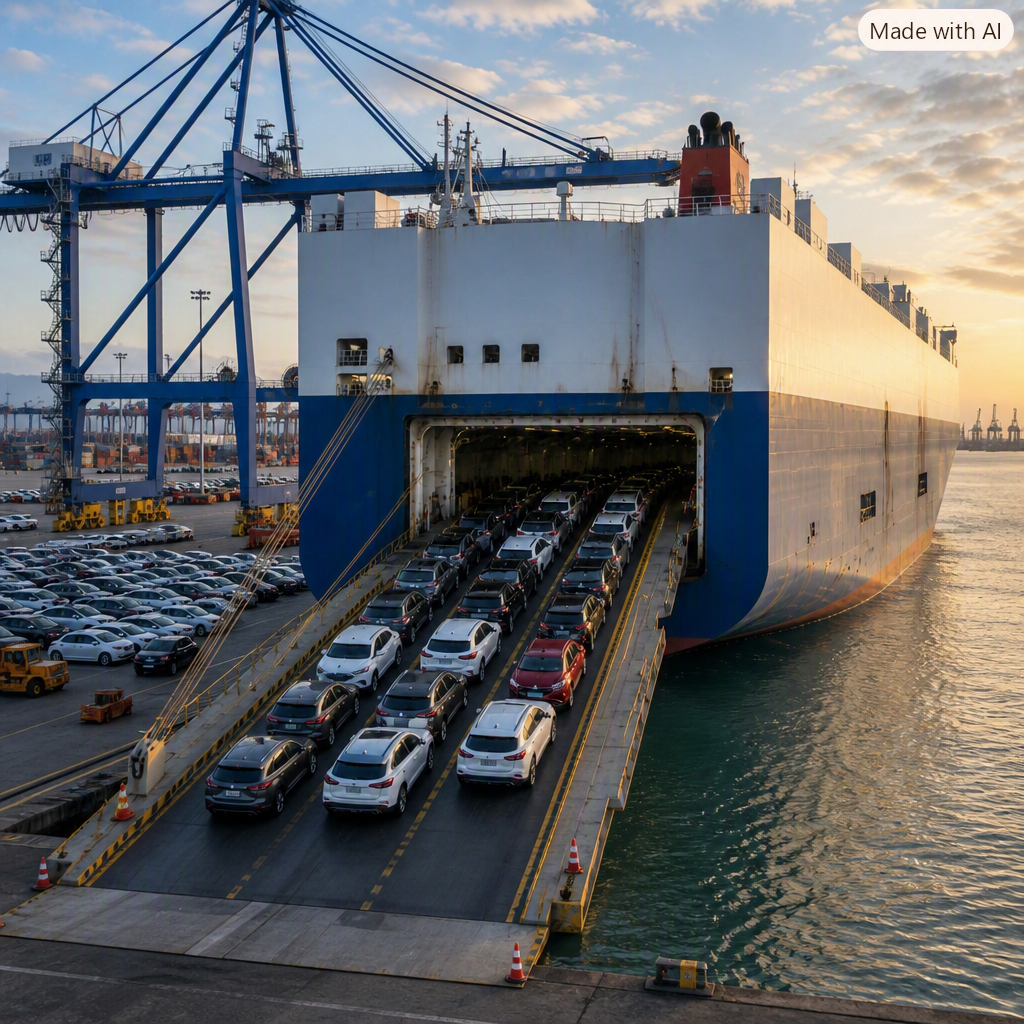
February 2026 began with a kind of quiet confusion inside U.S. dealerships — not panic, not shortage, but a strange, uneven disruption that didn’t match anything managers had seen in years. It wasn’t caused by domestic demand. It wasn’t caused by factory incentives. It wasn’t caused by interest rates or insurance premiums or buyer hesitation. It came from thousands of miles away, from a geopolitical conflict unfolding in the Red Sea, where shipping lanes had become unpredictable overnight.
The attacks on commercial vessels in the region didn’t dominate dealership conversations at first. Most managers weren’t reading maritime reports. Most salespeople weren’t tracking global freight patterns. Most buyers weren’t thinking about container ships when they walked into a showroom. But the disruption didn’t need headlines to make its presence felt. It arrived quietly, through allocation sheets that didn’t make sense, through trucks that showed up half‑loaded, through shipments that were delayed without explanation, through inventory mixes that looked like someone had shuffled the deck.
Dealers rely on rhythm. They expect certain trims to arrive in certain quantities. They expect certain colors to repeat. They expect certain segments to move in predictable cycles. When that rhythm breaks, even slightly, the entire store feels it. February 2026 was a month where rhythm didn’t just break — it dissolved.
Walk into a dealership during the first week of February and you’d see vehicles that weren’t supposed to be there yet. You’d see trims that normally arrive in pairs showing up alone. You’d see colors that rarely sell in certain regions suddenly appearing in multiples. You’d see managers staring at allocation sheets with a kind of puzzled irritation, trying to understand why the factory sent them three base‑model sedans and no mid‑trim crossovers. You’d hear salespeople asking why the shipment they were told to expect on Monday still hadn’t arrived by Thursday. You’d hear porters moving cars around the lot to make space for units that weren’t even confirmed.
The disruption wasn’t dramatic enough to create headlines, but it was disruptive enough to change dealership behavior. Managers who normally planned their month around predictable inventory found themselves improvising. They had to rethink advertising. They had to rethink pricing. They had to rethink which models to push and which ones to hold. They had to rethink how to talk to customers about availability without sounding uncertain. They had to rethink how to motivate salespeople when the inventory mix didn’t match the strategy they built in January.
The geopolitical cause of the disruption created a unique kind of dealership tension. This wasn’t a shortage caused by domestic production issues. It wasn’t a surplus caused by over‑allocation. It wasn’t a demand shift caused by economic pressure. It was a logistical distortion — a kink in the global supply chain that made certain vehicles arrive early, others arrive late, and others arrive in combinations that didn’t match regional demand.
Dealers like predictability. They like knowing what’s coming. They like planning around what they know. When predictability disappears, they become more cautious. They become more protective of certain units. They become more aggressive with others. They become more focused on what they can control, because the macro forces are too far away to influence.
The shipping gridlock also changed buyer conversations. Customers who came in expecting to see a certain trim were told it hadn’t arrived yet. Customers who wanted a specific color were told the dealership didn’t know when it would be available. Customers who were ready to buy were shown alternatives that didn’t match their preferences. Some buyers adapted. Others walked away. Others asked questions the dealership couldn’t answer. The uncertainty created a kind of ambient frustration that followed customers from the lot to the showroom to the finance office.
Salespeople had to adjust their approach. They couldn’t rely on the usual inventory flow. They couldn’t promise arrival dates. They couldn’t guarantee that the vehicle a customer wanted would be available next week. They had to learn how to sell around unpredictability. Some adapted quickly. Others struggled. The best salespeople learned how to frame the disruption as an opportunity — a chance for buyers to consider trims they hadn’t thought about, a chance to negotiate on units that arrived unexpectedly, a chance to take advantage of models that weren’t supposed to be in stock yet.
Managers had to adjust by rethinking which units to feature in advertising. Deciding whether to hold certain vehicles for high‑intent buyers or move them quickly to avoid aging. They had to communicate with the factory more often, even though the factory itself was dealing with the same uncertainty. They had to manage salesperson frustration. They had to manage customer expectations. They had to manage the tension between what the dealership wanted to sell and what the global supply chain actually delivered.
The shipping disruption also created unexpected winners and losers. Certain models that normally sell slowly became hot because they arrived early. Certain trims that normally move quickly sat longer because they arrived in the wrong combinations. Certain colors that rarely sell in certain regions suddenly became the only option available. Dealers had to adapt to these micro‑shifts in demand, even though they were caused by macro‑level geopolitical events.
The most interesting part of February 2026 wasn’t the disruption itself — it was how dealers responded to it. Some became more flexible. Some became more rigid. Some became more creative. Some became more cautious. The disruption exposed which dealerships were good at improvising and which ones relied too heavily on predictable inventory flow.
Buyers who understood the disruption gained leverage. They could negotiate more aggressively on units that arrived unexpectedly. They could push for better pricing on trims that weren’t supposed to be in stock. They could walk away from bad deals knowing the dealership didn’t want to lose a buyer in a month where inventory didn’t match demand. They could use the uncertainty to their advantage without ever mentioning the Red Sea or global shipping lanes.
February 2026 was a reminder that the auto market isn’t just shaped by domestic economics. It’s shaped by global logistics, by geopolitical conflict, by shipping routes, by supply chain vulnerabilities that most buyers never think about. When those forces shift, even slightly, they ripple outward until they reach the showroom floor. Dealers feel the ripple first. Buyers feel it next. The negotiation table feels it last.
The shipping gridlock didn’t break the market. It didn’t create chaos. It didn’t cause a shortage. But it created enough distortion to make February 2026 one of the strangest months in recent dealership memory — a month where global conflict quietly reshaped local inventory, and where buyers who paid attention could negotiate from a position of strength without ever mentioning the cause.
Read next
- The Corporate Layoff Ripple: How Recent West Coast Tech‑Sector Cuts in Changed Dealership Traffic Patterns
- CarBuyingTips.com | Blog | Barrett-Jackson Charity Auction Raises $1.76 Million for Ukraine Aid
- 2020 Shelby Mustang GT500 Pricing, Details Revealed at Barrett-Jackson Palm Beach
- Extended Car Warranty Costs