new cars, new car buying guide, car buying tips, new car purchase, buying a car, buy a car, carbuyingtips.com
Car dealers hate us...
You'll Love us!

new car prices, new car pricing, new cars, invoice price, invoicedealers.com, car dealers, car dealer cost.
Jeff's $avOmeterTM

$11,607,483

Add your savings HERE!

Get A FREE Price Quote:
New & Used Cars

Search CarBuyingTips.com


Buying New Cars
How To Buy New Cars
Buy Cars Online
First Time Car Buying Tips
Extended Auto Warranty Tips
Hybrid Car Buying Tips
Canadian Car Buying Tips
Top 10 Car Dealer Scams
Military Personel Car Buying
Our Reader's New Car Deals

Auto Finance
Auto Loans, Tips & Scams
Auto Refinance Tips & Scams
Bad Credit Auto Loan Tips
Used Car Loan Tips
Get Your Credit Report Online

Used Cars
Used Car History Reports
How To Buy Used Cars
Help Fight Odometer Fraud
Selling Your Used Car
Used Car Classifieds
Auto Auction Buying Tips

Car Insurance
Car Insurance Buying Tips

Auto Leasing
New Car Leasing Tips
ALG Residual Values
Car Leasing Software Reviews

Government Sites
Attorney General Sites
DMV Sites - All 50 States
Drivers License Sites

Take A Break
New Car Dealers - Ratings
Rate Your Dealer Experience
Free Spreadsheet Downloads
Humor: Alternate Car Names
RV Buying Tips & Scams
How To Jump Start A Car
LoserCars.com
Crash Of The Month Gallery
Furniture Buying Tips

How To Jump Start A Car

In this Section:

Tips on jump starting your car and reviving a dead battery. We'll teach you step by step everything you need to know to jump start a car with a dead battery. We'll also show you photos of the correct jumper cable setup, how to jump start a car battery, and give you dead battery troubleshooting tips and battery & alternator buying tips. Print this page & keep it in your trunk with the jumper cables.

The 3 biggest causes of dead car batteries are leaving your lights on, not maintaining your battery properly with the correct water levels (for older maintenance batteries), and breakdown of the diode bridge or voltage regulator in your alternator. Of course some people get a bad starter, but the odds of that are low compared to the other causes dead car batteries.

How To Use The Rest Of This Free Car Buying Tips Site:
Jump Right In By Reading Any Of the Guides Below

You'll save $2000-$4000 off MSRP after reading these guides:

Jump Starting A Dead Car Battery: A Few Precautions

  • Line both cars up so the batteries are as close as can be. Make sure the cars are in park, and both cars are turned off, and not touching each other before you connect the cables. Actually one of them is already off, or you wouldn't be in this predicament right? Make sure all headlights, blinkers, car radios and A/C's are off, radar detectors are unplugged, cell phones unplugged, everything off. Unplug all accessories from cigarette lighters and other power sockets from both cars. Jump starting a battery can crank 300+ volts through your system and the transients can destroy equipment. These voltage spikes are caused by inrush current, into the inductances in your electrical system.

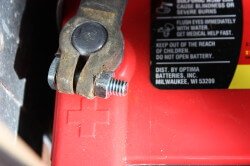
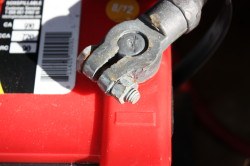
  • Familiarize yourself with the Positive (+) and Negative (-) terminals of both car batteries so you know exactly which one is which. All batteries are clearly marked so if you can't find it, it's probably under 1/8" of caked on corrosion around the terminals. Wipe off any battery acid that may have leaked.

  • If the battery is cracked and liquid is leaking out, DO NOT go further! Bite the bullet and go buy another battery and swap it out. If you try to jump start a battery with a crack in it, it will explode, and battery acid will dissolve your eyes (on the positive side though, it does get the red out). It makes no sense to jump a cracked battery, it will die in a few minutes.

  • Try to clean off any corrosion around the dead battery terminals, and if you have tools, loosen the wires from the terminals, clean them off, then retighten the wires to the shiny posts. Corroded posts prevent the power from getting through the cables and into your battery to revive it. If you have a file handy, try to file the metal battery posts until they are nice and shiny. In a pinch use pliers to clamp down and scrape off corrosion too as the metal is somewhat soft.

  • Usually the positive battery cable is red or orange, and usually the Negative (-) or ground cable is black, but always check for yourself to be sure.

Connecting The Car Battery Jumper Cables

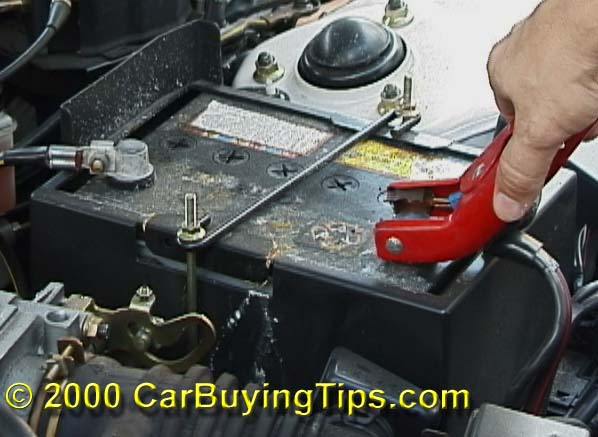
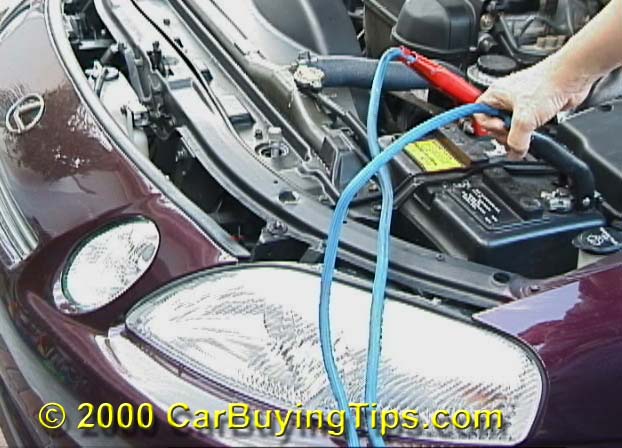
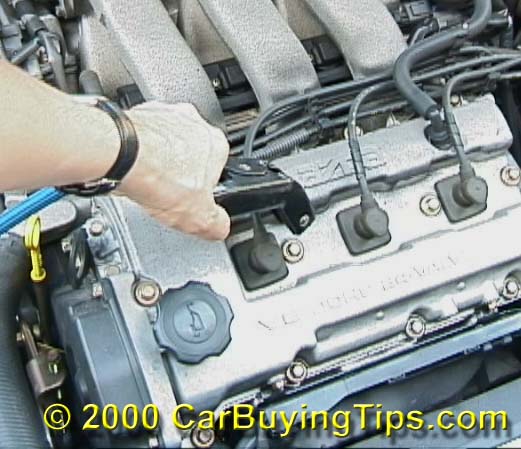
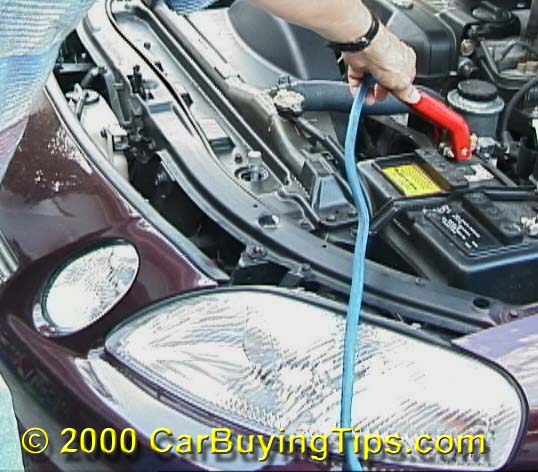
The cables must be connected in this exact order listed below, 4 easy steps. Wear protective eyewear! Click on the thumbnail pictures here for a larger view.

STEP 1: Connect one end of the Positive(+) cable to the Positive(+) post of the dead battery.

STEP 2: Connect the other end of the Positive(+) cable to the Positive(+) post of the good battery.

STEP 3: Connect one end of the Negative(-) cable to the Negative(-) post of the good battery.

STEP 4: Connect the other end of the Negative(-) cable to a good solid SHINY, NON PAINTED metal part of the engine on the dead car. Usually a giant shiny nut on the engine block will do. A painted, dirty, or oily nut will not work. You usually want to avoid placing the Negative(-) cable directly on the dead battery to minimize the chance for explosions. You should only use the ground post on the dead battery as a last resort. On this step you'll get a normal spark as you connect the ground and complete the circuit.

Why do the battery charger cables have to be connected in this order?
The reason why you connect the battery cables to the dead car battery first is you have 3 metal cable ends dangling and potentially touching metal car parts, so a dead battery is less likely to cause any sparking, since it has little or no voltage. So that is the safest starting point for your jumper cables. The 2nd battery cable clamp goes to the positive end of the good battery instead to minimize completing any circuits until we are ready to. Then the 3rd end of the battery cable goes to the ground of the good battery. Remember, we still have not completed the circuit yet, until the 4th battery cable clamp is attached to ground. This is why this order of attaching the battery cables to your car batteries is the safest way to do it. It minimizes unnecessary sparking until the charging circuit is completed. This is good practice because excessive and unnecessary sparking could cause car batteries to fail.

Since the bad battery is weak, and to prevent exploding, it's ground clamp gets connected last, but not directly to the ground battery post. To prevent sparking directly on the battery, you connect the 4th battery cable clamp to a metal frame part of the dead car, which is connected to the minus pole of the battery. Many people are easily confused by this step. They cannot figure out how this completes the circuit to the battery. Car batteries have their ground cable also wired to the chassis of the car, so by clamping to a good metal chassis point, this is electrically equivalent to connecting to the ground post of your car battery.

Dead Car Battery Starting Method # 1: Preferred method of starting the dead battery
Try this method before you try Method #2. A guy named Doug from Canada sent in this tip. He's boosted cars a lot in winter and has found that it's critically important to shut off the boosting car’s engine during the moments of actual cranking of the car with the dead battery. This does however reduce available power to the dead car because the boosting car's alternator isn't running, Doug has had a number of "live" boosts make the boosting car's alternator diodes either fail outright or die very prematurely from the extreme current draw on the alternator while cranking the engine on the bad car. So the safest method is to have the good engine running a few minutes to charge the dead battery. Then shut off the good car's engine and disconnect the cables and start the bad car's engine. This method does not always work, so if Method #1 does not work for you, try Method #2. Personally, I've never had a problem with Method #2, but the risk is there. I still think the best thing for you to use if your car is near a source of AC current, is a home car battery charger/jumper. In the Method #1 above, I might add that if you keep trying to crank the bad car and it won't start, then stop this process before you drain the good car's battery. You don't want 2 dead car batteries on your hands. You may need to start the good car's engine and proceed with original method.

Dead Car Starting Method # 2: Gentlemen, Start Your Engines!
Start the good car's engine, and make sure the headlights are off, to allow the maximum amount of power to get to the dead battery. Let the good car's engine run a minute or so before attempting to start the dead car. Sometimes you get lucky and the dead battery will jump start right away, sometimes it takes a few minutes. If you're lucky and have a voltmeter built into your dash on the dead car, turn the key to the accessory setting and read the voltage coming into your charging system. Ideally you want between 12 and 13.6 volts, but some cars can start at 10 volts. If your dead car's interior dome light comes on, it's a great sign that you've connected the cables right. Now shut all doors and dome lights and try to start the car. If it sounds like it's trying to crank but won't turn over completely, give it a few more minutes and rev the engine moderately on the good car. You may also need to play with the cable grips to get a better connection, and use that in dash voltmeter to its fullest if you have one. You'll get a normal sparking as you move the cables around a bit. Let's assume your engine started ok, but if it did not start, see the troubleshooting section further down this page.

Removing the jumper cables
Now that your dead car has been successfully jump started, you can remove the cables in the reverse order that you connected them being careful not to let the battery cable clamps from touching each other:

  1. Disconnect the Negative (-) cable from the engine block of the car that was jump started. This breaks the circuit.
  2. Disconnect the other end of the Negative(-) cable from the Negative (-) post of the good battery.
  3. Disconnect the Positive (+) cable from the Positive (+) post of the good battery.
  4. Disconnect the other end of the Positive(+) cable from the Positive (+) post of the dead battery.
IMPORTANT TEST: See if your formerly dead car can restart on its own now
Here's a test I do every time I jump start a car. After your revived car has been running a few minutes, turn off the engine and see if it will restart on its own, no cables attached. This is a good test to see if your charging system is working, and if successful, it's a good indicator that you won't have problems driving home. If the engine cannot crank on it's own, you'll have to jump start the car again and it may mean you'll have problems getting home. If your alternator is not putting out 13.6 volts, it means the battery is not charging. Turn on the headlights and if you have an in-dash voltmeter, see if it drops below 12 volts. Also press the brake pedal and see if the voltage drops, or if your dome lights dim. If it drops down to 10 volts, you may have a lot of trouble on the way home, in the form of your car stalling again when you hit the brakes. Sometimes if your alternator is in such bad shape, and can't put out even 12 volts after jump starting just pressing the brake pedal and illuminating the rear brake lights is enough to cause the car to stall. If your car does not restart on its own, it's a good sign that something is really wrong, either the battery, or your charging system. Have someone follow you home.

Troubleshooting Tips
You tried the steps above and your car still won't start. Possible causes might be the dead battery is not getting voltage from the good battery due to bad cables, or the most common reason: a bad connection from good battery cables. Having a cheap voltmeter solves this problem in 2 seconds.

Don't wait until it's too late to do something about your dying car battery!
We've all been in panic mode where the car does not crank over 100% so we try it once again and it finally cranks over amid a sigh of relief. That's the time to get your electrical system looked at as soon as possible. Don't procrastinate and end up back here looking for jump starting tips in a few weeks.

Tips for maintaining your charging system and preventing problems
Your battery posts should be clean, and there should be no corrosion or grease around the posts, and the entire top of the car battery should be clean and dry, just like you see it in the auto parts store. Corrosion will rust the cable connectors that attach to the battery terminals, cutting off the supply of current from your battery to the car. For some people who are having trouble starting their car, just cleaning the battery terminals may be all they need to make their troubles go away.

Got battery post corrosion?
Use a battery post brush to clean the posts and make them shiny again for maximum performance. Also brush clean the battery cable clamps that attach onto the battery posts. Most people don't know that on older maintenance car batteries they must maintain the water level in their battery. In hot summer months, the water level can drop significantly, preventing the electrolytic plates from holding a charge. The problem is that when you first notice that your engine is having a hard time starting due to the battery, the damage has already been done. Adding water to the battery at this time may help for a short while, but your battery is most likely going to die soon.

Auto parts stores can quickly diagnose your dead car battery for free!
Many auto parts stores have a meter that they can attach to your battery and in 10 seconds they'll tell you if your charging system has any problems. So before you go to buy a new battery have them tell you if there really is a problem.

Tips for buying car batteries
Most car battery warranties are a joke, because you still have to shell out money for a new car battery when your old one dies. They claim 7 year warranties, but your battery may only last 2 or 3 years then you bring it in when it dies and they "prorate" you a discount off another battery. So if your 7 year battery dies at 36 months, they give you a 50% prorated discount off a new 7 year battery, you don't get a new battery for free. If you don't have your receipt for the battery you bought 3 years ago, you'll get nothing, so save receipts for your diehard batteries and alternators. You might ask, "who's going save their battery receipt?". Lots of people do. Keep it in the maintenance records notebook that you create when you buy a new car. Whenever you need the receipt you'll know where to find it. When I owned my Trans Am, I was either replacing the alternator or the battery every year, so I had to keep the receipts. Be kind to your environment and use proper battery disposal methods. Always bring the dead battery to turn in to the auto parts store. Some states may have a battery disposal fee that you pay when purchasing a new automotive battery. Sometimes when you buy an alternator at the auto parts stores, you have to trade in your old one, so they may charge you a deposit until you bring the old core in. Consult your auto maker to decide which battery you should get. I used to buy the highest rated (700 Cold Cranking Amps) battery I could find for effortless starting.

Get A good set of jumper cables to keep in your trunk at all times
Everyone should have a good set of jumper cables to keep in the trunk. If you don't know whether you have a set, you better find out right now. You don't want to be caught out in the middle of cow tipping country with a dead battery and no cables and no beer, because you forgot you lent your cables to someone and never got them back. Don't skimp on your cables either. Just as a bad DJ can ruin a good wedding, cheap battery jumper cables can and do work against people all the time. I don't recommend getting any cables under $20 no matter how tempting it might be to save a few bucks. The cheap ones just don't have what it takes. I just go to Sears Automotive and buy the biggest meanest kick ass set of cables I can find there! You want the thickest cables you can get, as their ability to deliver more current to the dead battery often means the difference between starting and not starting your dead car. It can mean the difference between making the football game on time, or making to your concert on time. Several times in the past I've watched people try with no success to jump start a car, then I connect my cables and the car started right up. I've gotten a lot of high fives over the years for jump starting cars when people were ready to call a tow truck. If your car does not have a voltmeter built into the in dash gauges, I highly suggest you get a cheap $10 home depot special for your trunk with the battery cables. The voltmeter is a very valuable tool to have when you're troubleshooting a car that won't jump-start. Usually it's an issue of the voltage not getting from the good car through the cables and onto your dead battery. The culprit is usually just a bad connection, or jumper cables that are old and corroded, or just not thick enough to handle the cranking amps. The voltmeter will tell you instantly, and if it displays less than 12 volts across your dead battery terminals, you know it's simply not getting the voltage from the good battery. Radio shack makes a tiny $17 Auto-Ranging Tester that fits in your shirt pocket. If you know someone who just bought a car, buy them one as a gift.

Other useful tips for your car battery

So there you have it, everything you need to know for a best odds shot at jump starting a dead car, and some good preventative maintenance tips as well. We'd love to hear your comments or suggestions on this article. Now, let's jumpstart your new car buying strategy.

cars, used cars, new cars, used car prices, car insurance, car buying guides, used car loans, car prices, car for sale, new car prices, used car values, old cars, car sale, import cars, used car sale, car buying, carbuyingtips, carbuyingtips.com

Click Here To Get Started:
How To Buy A New Car & Avoid Scams


Jump to any chapter. I suggest you read each chapter in order.
Chapter 1
Get your credit report, how to get a car loan, scams, online car loans, first time car loans, budget & loan excel spreadsheets, credit repair.
Chapter 2
Reviews of internet discount car buying sites, new car prices, find dealer's invoice cost. Get a new car quote.
Chapter 3
What to bring to a dealership, what to say, how to act, what not to do, what to look for at the dealership, and a glossary of all dealer fees.
Chapter 4
How to read dealer invoices, finding dealer's cost, how much to offer the dealer, buyers offer spreadsheet, examples, trade-ins.
Chapter 5
Negotiating tips, dealer scams & tricks to watch out for, dealing with aggressive salespeople, choosing between rebates or low APR loans.
Chapter 6
Close the deal, avoid needless extras, scams in the business office, extended warranty scams, options, buying warranties online.
Chapter 7
Actual misleading dealer ads, and what to do when you've been ripped off, customer satisfaction surveys, how I bought my Lexus.
cars, autos, new car prices, used car prices, car buying, dealer cost, dealer invoice, car loans, auto loans, auto financing
CarBuyingTips.com

The information on this site is Copyright © 1996-2010 ConsumerNet, Inc. This site is solely for your personal use. You may link to these pages or print them out for your own personal use, but no parts of these pages can be reproduced, sold, or transmitted in any form without explicit written permission. By copying or paraphrasing the intellectual property on this site, you're automatically signing a binding contract and agreeing to pay a fee of $10,000 per instance per week payable immediately.